






























































































































































Featured image by Stephen Margo on Unsplash
Most students lose competitions before they even register. They overthink the team, wait for the 'perfect idea,' and end up spectating while their batchmates collect certificates and PPO calls. Here's the truth nobody tells you at orientation: competitions are winnable, and they're far more learnable than your CGPA suggests.
Whether you're a first-year at NIT Warangal or a third-year at IIT Bombay who's never submitted a single deck — this guide is your unfair advantage. We're breaking down hackathons, case competitions, and quizzes with the kind of insider strategy your senior topper never bothered sharing.
Why College Competitions Are the Most Underrated Resume Boosters
Recruiters at top firms see hundreds of resumes with identical 8+ CGPAs. What makes them pause? A line that says '1st place, Smart India Hackathon 2024' or 'Winners, IIM Ahmedabad's L'Affaire case competition.' That's the game.
Competitions give you real problem-solving reps under time pressure — something no classroom assignment replicates. They also build your network faster than any LinkedIn post ever will.
- Hackathons: Build something functional in 24–48 hours. Tech-heavy, but non-coders can contribute in design, research, and pitching.
- Case Competitions: Solve a real business problem for a company or hypothetical scenario. All about structured thinking and sharp presentation.
- Quizzes: General knowledge meets domain expertise. Often underrated but insanely valuable for building recall speed and lateral thinking.
Hackathons: How to Stop Building for Judges and Start Winning
Pick Your Category Like a Strategist, Not a Fan
Most beginners pick hackathon themes based on what they find interesting. Smart beginners pick themes based on where the judging criteria and their team's skills overlap the most.
If you're a CS student who can barely use Figma, don't register for a UI/UX-heavy track. If you've done one ML project on Kaggle, a computer vision track with beginner-friendly datasets is your sweet spot.
Your Team Is Your Actual MVP
The perfect hackathon team has this unspoken balance:
- One person who can code under pressure without Googling every syntax error.
- One person who can make a slide deck that doesn't look like a 2009 PowerPoint template.
- One person who can pitch — confidently, clearly, without dying inside when a judge asks a hard question.
- One person who can research, write documentation, and handle the parts nobody else wants to do.
Four people who all code and nobody who can present is a recipe for a demo that impresses no one. Balance the skill stack before you even think about the idea.
The 80/20 Rule of Hackathon Ideas
You don't need a revolutionary idea. You need a well-scoped, clearly communicated, barely-functional prototype that solves one problem extremely well. Judges have seen 40 teams in one day. The team that shows a clean demo of one working feature beats the team that promises ten features with a broken backend every single time.
- Define the problem in one sentence before writing a single line of code.
- Build the MVP first. Add features only if you have time left.
- Practice your pitch at least three times before the final presentation slot.
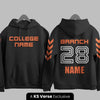
And yes, wear something that makes you look like you mean business — not your worn-out hostel hoodie. Half the IIT Delhi students competing at inter-college hackathons these days are showing up in clean IIT Delhi drops from KS Verse — it's a subtle flex that signals you take this seriously.
Case Competitions: The Art of Sounding Smarter Than You Are (Until You Actually Are)
Structure Is Everything
Case competitions are won by teams who present a clear problem statement, a structured approach, and a recommendation backed by data — not by the team with the most creative slides.
Learn these frameworks until they're second nature:
- MECE (Mutually Exclusive, Collectively Exhaustive): Your analysis should have no overlaps and no gaps.
- Porter's Five Forces: For any competitive landscape analysis.
- 4Ps / STP: For marketing cases.
- NPV and break-even analysis: For financial cases — even a basic Excel model goes a long way.
The Slide That Wins the Room
Your executive summary slide is more important than everything else combined. Judges skim. Make your recommendation, the top three supporting insights, and the implementation roadmap crystal clear within the first 90 seconds of your presentation.
Practice ruthless editing. If a slide doesn't directly support your recommendation, cut it. If a graph takes more than five seconds to understand, simplify it.
Where to Practice Before the Real Thing
- Victor Cheng's YouTube channel and casebooks — free, genuinely useful.
- Your college's consulting or strategy club case nights.
- PrepLounge for peer-to-peer mock case sessions.
- Past case decks from IIM, ISB, and IIT competitions available on LinkedIn.
If you're from NIT Trichy or NIT Rourkela, your campus clubs are more active than you think. Check your ERP notice board — or just follow what the NIT Trichy community on KS Verse is wearing to their next big fest, because those events almost always run parallel case comps.
Quiz Competitions: The Sleeper Category That Pays Out Big
Quizzing is criminally underrated as a competitive sport. The top quizzers in India — people who've won Landmark, BC Roy, and Tata Crucible — are treated like minor celebrities in campus circles. And the entry barrier is surprisingly low if you're willing to put in the prep.
How to Actually Get Good at Quizzing
- Read laterally, not just deeply. Quizzes reward broad knowledge — history, science, pop culture, business, sports, music. The person who only reads tech blogs will get destroyed by the person who reads everything.
- Workback from answers. When you practice with old quiz papers, don't just check if you got it right — understand why the answer is what it is. The logic trail is what sticks.
- Use spaced repetition. Apps like Anki work. Build decks around quiz themes — logos, Nobel winners, eponymous laws, famous firsts.
- Watch recorded quiz finals on YouTube. Channels dedicated to Indian quizzing exist. Study how top quizzers eliminate wrong options under pressure.
Team Quizzing vs Solo: What Nobody Explains
Team quizzes reward complementary knowledge sets, not identical ones. Don't team up with someone who knows exactly what you know. Pair a science nerd with a history buff and a sports encyclopaedia — that combination wins more rounds than any single domain expert.
Tata Crucible, for instance, is one of the most prestigious business quizzes in India. BITS Pilani students have a strong track record there — if you're one of them, start building your knowledge base now and rep the campus right. The BITS drops on KS Verse are already a staple at their quizzing society meetups for a reason.
The Mindset Shift That Separates First-Timers from Consistent Winners
Here's what the students who consistently win across competitions have in common — and it has nothing to do with intelligence.
- They enter more than they feel ready for. Every competition attempt teaches you something that no prep session can. Losing your first hackathon in round two is worth more than watching three YouTube tutorials.
- They debrief ruthlessly. After every loss, they ask judges for feedback, review their own deck or pitch, and write down exactly what broke down.
- They build a core team early and stick with it. The best competition teams at IIT Madras and IIIT Hyderabad are groups who've competed together across formats — they develop shorthand, trust, and execution speed that new teams simply can't match.
Speaking of IIIT — if you're preparing for your first inter-college competition season, the IIIT merch collection on KS Verse has become the unofficial uniform of students who show up to compete looking like they've already won. A 320GSM heavyweight hoodie from the Campus Legend tier doesn't just keep you warm through a 36-hour hackathon — it's armor.
Quick-Start Checklist for First-Time Competitors
- Register for at least one competition this semester. Just one. Commitment over readiness.
- Form a team with complementary skills, not just your closest hostel friends.
- Study two to three winning submissions from previous years before building your own.
- Practice your pitch or presentation out loud — not just in your head.
- Show up dressed like you take yourself seriously. First impressions in competition rooms are real.
The students who win consistently aren't smarter than you. They just started earlier and failed more often. Your first competition doesn't need to be your best — it just needs to happen. Register for one this week. Build the team. Show up. The rest follows.
And when you do win that first trophy, celebrate in something worth wearing — the KS Verse all-campus drops collection has 240GSM oversized tees and Batch Nexus customizable merch that your entire team can co-ordinate in. Because winning looks better when you look the part.