































































































































































Featured image by jaikishan patel on Unsplash
Most study groups at IITs and NITs die before the first mid-sem ends. One person does all the work, two are on their phones, and someone always says "yaar kal karte hain" until the exam is literally tomorrow. If that sounds familiar, you don't have a study group — you have a distraction committee.
Here's how you actually build one that works.
Why a Study Group Can Make or Break Your CGPA
Solo studying has a ceiling. You can only catch your own blind spots for so long before you start memorizing wrong concepts with full confidence.
A well-structured study group at IIT or NIT gives you something no textbook can — real-time peer correction, division of labor, and accountability that your 11 PM self desperately needs. Research backs this up: active recall through group discussion retains information 50% better than passive re-reading. And honestly, your seniors' WhatsApp groups won't save you in the exam hall.
Step 1 — Choose Members Like You're Drafting a Startup Team
This is where 90% of study groups go wrong. People pick friends, not contributors.
The ideal IIT or NIT study group has 3 to 5 people — any larger and it becomes a chai break with notes. Here's exactly who you need:
- The Concept King/Queen — The one who actually understands the derivations and can explain them without reading off a page.
- The Problem Solver — Strong at numericals and can grind through practice sets fast. Invaluable before gate-style exams.
- The Organized One — Knows which units are in the syllabus, tracks deadlines, and makes sure the group doesn't spend 40 minutes deciding where to sit.
- The Devil's Advocate — Asks annoying questions like "but why does that formula work?" This person saves the whole group from rote-learning traps.
- You — Know your own strength and own it. Don't join a group to leech; bring something to the table every single session.
Avoid people who consistently show up late, treat the group as a notes-photocopying service, or derail every session into campus gossip. Be ruthless early. It saves friendships later.
Step 2 — Set Non-Negotiable Ground Rules on Day One
No rules = no group. It's that simple.
Your first session should be 30 minutes of setup, not studying. Decide these upfront:
- Meeting frequency and duration — Three 90-minute sessions per week beats one chaotic 5-hour marathon before exams.
- Phone policy — Phones face-down or in bags during active study blocks. No exceptions, no "I'm just checking one thing."
- Topic ownership — Rotate who prepares and teaches each topic. Teaching is the fastest way to learn.
- Accountability check-ins — Start each session with a 5-minute debrief: what did everyone cover since last time?
- Exit clause — If someone misses three sessions without reason, they're out. Sounds harsh. It isn't. Dead weight kills momentum.
Write these down in a shared doc. Verbal agreements don't survive the pressure of end-sems.
Step 3 — Pick the Right Location (This Matters More Than You Think)
Your hostel common room is a graveyard for focus. The messing hall is worse.
The best spots on most IIT and NIT campuses are the department reading rooms, central library study halls, and open-air seating near academic blocks during off-peak hours. Find a spot with minimal foot traffic, decent lighting, and zero proximity to food — hunger is a productivity killer and a meetup-ender.
If you're studying late into the night in those cold library halls, you already know the uniform: a solid heavyweight hoodie that you can wear for three hours without wanting to take it off. The kind of thing you see at every NIT Trichy library session or packed into the backpacks of students grinding at IIT Delhi during internals week. KS Verse's 320GSM heavyweight hoodies have become something of a campus staple for exactly this reason — built for long hours, not just aesthetics.
Step 4 — Structure Every Session Like a Pro
Unstructured study groups are just hangouts with guilt.
Use this simple session framework that actually works in the engineering college context:
- First 10 minutes — Recap and intent setting. What's today's goal? Be specific. "We'll finish Unit 3 of Signals" beats "let's study together."
- Next 40 minutes — Individual deep work. Everyone works on their assigned portion silently. No interruptions unless genuinely stuck.
- Next 20 minutes — Teach-back round. Each person explains their portion to the group. Questions are encouraged. This is where real learning happens.
- Final 20 minutes — Problem-solving sprint. Pick 5-10 past exam questions related to today's topic. Solve together, discuss approaches.
- Last 5 minutes — Next session plan. Assign topics, confirm time, and actually put it in your calendar.
This 90-minute structure is tight enough to stay focused and productive enough to feel progress every single session.
Step 5 — Use Shared Resources Without Creating Dependency
There's a fine line between collaborative learning and collective helplessness.
Build a shared folder — Google Drive works fine — with solved PYQs, formula sheets, and condensed notes. But here's the rule: you contribute before you consume. If you only download and never upload, you're not part of the group, you're a parasite.
Rotate who makes the summary sheet after each major topic. The person making it learns the most. The rest get a clean reference. Everyone wins.
Common Mistakes That Destroy Study Groups at IITs and NITs
You'll recognize at least three of these from a group you've already been in.
- Starting only before exams — A study group built three days before mid-sems is just panic with company. Start early in the semester.
- No clear skill differentiation — If everyone in the group is strong in the same subject and weak in the same subject, you have an echo chamber, not a study group.
- Letting one person carry everything — The person who always prepares notes and explains concepts will burn out and quit. Redistribute constantly.
- Mixing too many branches — Cross-branch groups can work for aptitude and placements, but for core subjects, same-branch and same-section groups are far more efficient.
- No end goal — "Study together" is not a goal. "Finish Units 1-4 and solve 30 PYQs before the mid-sem" is.
When to Use Your Study Group for Placement Prep
By your 5th or 6th semester, your study group should naturally evolve into a placement prep pod.
The same structure applies — divide topics, teach back, drill problems — but now your material shifts to DSA, core concepts, and aptitude sets. Companies recruiting from IITs and NITs reward students who've done sustained, structured prep over those who crammed in the last month. Your group is your edge.
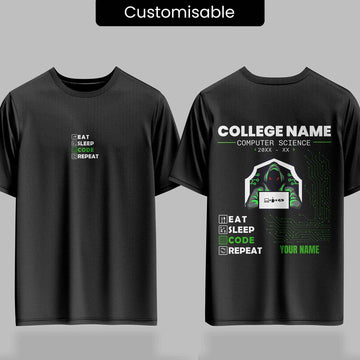
This is also when campus identity starts to matter more — batch hoodies, department tees, the subtle flex of wearing your college's name while grinding mock interviews. Students at IIT Bombay and NIT Warangal have been rocking the KS Verse Batch Nexus customizable merch for exactly this — something that marks the grind era of your batch without looking like a corporate giveaway.
The Long Game — Your Study Group Becomes Your Network
Here's what nobody tells you: the people in your study group become your strongest professional references five years later.
They've seen you work, seen you fail, seen you figure it out. That's worth more than a LinkedIn connection from a networking event. Treat the group with that long-term lens. Show up, contribute, be honest about what you don't know, and help others figure it out.
The students who look back at their IIT or NIT years and say "those were the best times" almost always had a tight, functional crew they studied hard with. Not a 40-person WhatsApp group that shared PDFs — an actual group of 4 people who held each other accountable and pushed each other forward.
If you're at any campus across India's top engineering and medical colleges, check out the full campus drops at KS Verse — because the grind deserves to look good too. The 240GSM oversized tees are practically the unofficial uniform of late-night library sessions at this point.
Build the group. Set the rules. Show up. The CGPA follows.