





































































































































































Featured image by AMIT RANJAN on Unsplash
Your roommate blasts EDM at 2 AM. You're trying to solve differential equations. Your brain is simultaneously running a war simulation. Sound is not neutral — it is either your biggest weapon or your worst enemy during a study session. And yet, most of us just hit shuffle on Spotify and hope for the best.
There's actual neuroscience behind why your study playlist matters, and getting it right could be the difference between retaining 40% of a chapter versus genuinely understanding it. Let's break this down like a third-year who finally figured out how to study smart instead of just studying long.
What Actually Happens to Your Brain When You Study with Music
Your brain isn't a single machine — it's a chaotic committee. The prefrontal cortex handles logic and deep thinking. The limbic system processes emotion. The auditory cortex never clocks out.
When you play music, your auditory cortex activates whether you want it to or not. That's competing neural bandwidth. The question isn't whether music affects focus — it always does. The question is: does it help or hurt?
The Mozart Effect — Real or Overhyped?
In 1993, a study suggested that listening to Mozart temporarily boosted spatial reasoning. The internet turned this into "classical music makes you smarter." That's not what the study said.
What's actually true: music that matches a certain cognitive arousal level can prime your brain for focused work. It's not about Mozart specifically. It's about tempo, complexity, and lyrical content.
The Real Rules of Building a Study Playlist That Works
Not all music is created equal when it comes to studying. Here's what the research and common hostel wisdom both agree on:
- No lyrics in your native language. Language-processing areas of the brain activate when you hear words you understand. That's direct interference with reading and writing.
- Tempo between 60–80 BPM mirrors a resting heart rate and helps maintain calm, sustained focus — ideal for long study blocks.
- Consistent volume. Sudden drops or spikes in music pull your attention away involuntarily. Flat, ambient sound is your friend.
- No emotional anchoring. If a song reminds you of your ex, your last trip, or your favourite movie — skip it. Your brain will drift into memory mode.
- Familiarity over novelty. New music triggers dopamine and curiosity responses. Save new drops for the gym, not the grind.
The Four Study Modes and Which Playlist Fits Each
Not every study session is the same. A 3-hour deep revision block before your end-sem is cognitively different from a 30-minute formula review. Match your music to your mode.
Mode 1: Deep Work (Derivations, Proofs, Case Studies)
This is the hardest cognitive load. Your brain needs maximum working memory and zero distraction.
- Brown noise or pink noise over white noise — lower frequencies, less ear fatigue
- Ambient instrumental: Brian Eno, lo-fi jazz, or Japanese study music
- Binaural beats at 40Hz (gamma waves) — linked to improved concentration in multiple studies
Mode 2: Active Reading and Note-Taking
You're processing information but not generating original thought. Slightly more musical stimulation is fine here.
- Lo-fi hip-hop at moderate volume
- Acoustic instrumental covers of songs you know
- Film scores without dominant motifs (Hans Zimmer's Interstellar OST is genuinely elite for this)
Mode 3: Revision and Flashcards
Repetition tasks are lower cognitive load. A bit more energy in the music actually helps keep you alert.
- Upbeat lo-fi or chillhop at 80–100 BPM
- Study playlists on Spotify specifically curated for focus (search "deep focus" or "study beats")
- Video game soundtracks — designed specifically to keep players engaged without distracting them
Mode 4: The Pre-Exam Pump-Up
Twenty minutes before you walk into the exam hall. This is psychological priming, not studying.
- Whatever genre makes you feel confident and sharp — this is personal
- Keep it short. You don't want to spike cortisol right before a paper
The Hostel Problem: When You Can't Control Your Sound Environment
Let's be honest. If you're in a hostel at NIT Trichy or cramming in a shared room at IIT Bombay, silence is a privilege you don't have. Your wingmate is watching reels. The corridor smells like instant noodles and regret. Your study playlist becomes your personal acoustic shield.
A decent pair of over-ear headphones with passive noise isolation changes everything. You don't need ANC to block out hostel chaos — you need consistent ambient audio that masks irregular noise spikes (conversations, doors, footsteps) which are the actual focus killers.
This is also exactly the kind of late-night grind energy that pairs with throwing on a 320GSM heavyweight hoodie from KS Verse — the kind of thing that becomes your unofficial uniform for every serious study block, whether it's 11 PM or 3 AM.
Silence vs. Music: What the Data Actually Says
A 2021 study published in Applied Cognitive Psychology found that silence outperforms music for tasks requiring high verbal working memory — like writing answers, solving logic problems, or reading dense theory. But music outperforms silence for repetitive, monotonous tasks where alertness drops.
The takeaway isn't "music bad." It's: be intentional about when you use it.
- Writing essays or detailed answers? Silence or brown noise only.
- Solving numerical problems you already understand? Lo-fi is fine.
- Reading a new concept for the first time? Kill the music for 15 minutes, then bring it back.
Building Your Personal Study Playlist: A Step-by-Step System
Stop relying on algorithm-generated playlists. Build one that's yours. Here's how:
- Start a blank playlist. Name it after your goal — "End-Sem Grind" or "Placements Prep" hits different than "Chill Vibes."
- Add 2–3 hours of instrumental tracks so you're not hunting for music mid-session. Interruption kills flow state.
- Test it for one full Pomodoro block (25 minutes). If you caught yourself listening to the music rather than studying, it's too complex.
- Set a consistent volume level — around 50–60% on most devices maps to roughly 50–65 decibels, the research sweet spot for focus.
- Never shuffle essential playlists. Your brain starts to expect the sonic environment. Predictability = fewer micro-distractions.
The Identity Layer: What You Wear While You Study Actually Matters Too
This sounds like a stretch until you think about behavioral psychology. Your environment — including what you're wearing — signals your brain what mode you're in.
Students at BITS Pilani and IIIT campuses across India have caught on to something: having a "study uniform" — even if it's just a specific oversized tee — creates a Pavlovian trigger. You put it on, your brain knows it's time to work.
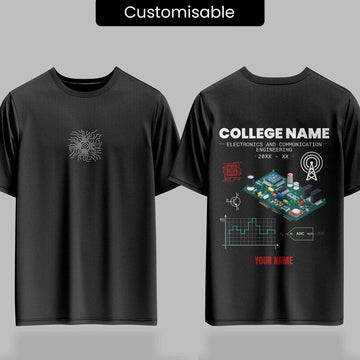
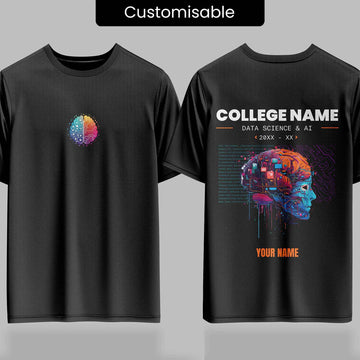
KS Verse's 240GSM oversized tees have quietly become that piece for a lot of students — soft enough to wear for six hours straight, structured enough that you don't feel like you've given up on life. Combine that with a curated study playlist and you've built a complete sensory ritual around focus.
If you want to rep your campus while you grind, explore all campus drops here — from IITs to NITs to VIT to AIIMS. The Batch Nexus customizable merch is also worth a look if your study group has the energy to build something together.
Quick Reference: The Study Playlist Cheat Sheet
- Deep derivations / proof writing: Brown noise or silence
- Reading new material: Silence, then ambient after 15 min
- Note-taking / summarizing: Lo-fi instrumental, 60–75 BPM
- Revision / flashcards: Chillhop or video game OSTs
- Pre-exam mental prep: Whatever makes you feel sharp
- All-nighter fuel: Binaural beats + consistent ambient layer
Your study playlist isn't just background noise — it's cognitive infrastructure. Treat it like you'd treat your notes or your schedule. Build it deliberately, test it honestly, and adjust it for what you're actually doing in each session.
The students pulling top CGPA in brutal departments aren't just studying harder. They've engineered every variable in their environment — sound included. Now you have the framework. Use it.