

























































































































































































Featured image by Church of the King on Unsplash
Your 9.2 CGPA won't save you if you're one-dimensional. Harsh? Maybe. But ask any final-year student who watched a 7.4-pointer walk into a ₹40 LPA role while they're still waiting for a shortlist. The difference wasn't luck. It was skill stacking — and the T-shaped model that placement cells quietly wish they could teach but never do.
What Is Skill Stacking? (And Why It's Not Just Another LinkedIn Buzzword)
Skill stacking is the deliberate layering of complementary skills to create a rare combination that's genuinely hard to replace. Think of it like this: one skill makes you a commodity. Ten random skills make you confused. But one deep skill paired with 4–5 strategic adjacent skills? That makes you the candidate every interviewer circles in red.
The T-shape metaphor is simple. The vertical bar of the T is your depth — your core technical domain (DSA, VLSI, finance, bio-tech, whatever your branch is). The horizontal bar is your breadth — communication, data literacy, product thinking, domain knowledge outside your lane.
Companies hiring from campuses in 2026 are explicitly filtering for this. One-trick ponies are out. Versatile builders are in.
Why 2026 Placements Are Fundamentally Different
The placement landscape shifted hard post-2023. AI tools eliminated entry-level tasks that used to justify hiring juniors. Companies now want students who can think across functions, not just execute within one.
Here's what's changed on the ground:
- Roles like SDE-1, analyst, and consultant now come with cross-functional expectations from Day 1
- Case interviews now test product intuition, not just quant — even for pure tech roles
- Startups (who are doing aggressive campus hiring in 2026) explicitly want generalist-specialists
- PPOs are being extended to students who demonstrated range during internships, not just technical output
The student grinding only LeetCode in their hostel room at 2am? Respect the grind. But if that's all they're doing, they're building the vertical bar of the T and forgetting the rest of the structure.
How to Build Your T-Shape: The Actual Roadmap
Step 1: Lock In Your Vertical (Your Non-Negotiable Depth)
Pick one domain and go genuinely deep. Not surface-level deep. Deep enough that you can teach it, debate it, and build something real with it.
- CS/IT students: Systems design + one specialization (ML, backend, security)
- ECE/EEE: Embedded systems or VLSI + one software layer (Python, firmware)
- Mechanical/Civil: Core domain + simulation tools + one data skill
- Bio/Pharma/AIIMS students: Clinical or research depth + regulatory/data literacy
If you're at any of the IITs or NITs, your peers are setting the benchmark. The IIT Bombay and NIT Warangal circles are already running deep technical clubs, reading groups, and open-source collectives. Find your people. Build your depth there.
Step 2: Add the Horizontal Bar — Strategically, Not Randomly
This is where most students mess up. They hear "build breadth" and start doing 12 random courses on Coursera. Breadth must be adjacent to your vertical, not random.
The best horizontal skills to stack in 2026:
- Communication & writing: Can you explain your work to a non-technical PM or client? This is rarer than any DSA skill.
- Data fluency: Even if you're not a data scientist, being able to read a dashboard, run a SQL query, or interpret an A/B test makes you dangerous in any role.
- Product thinking: Understanding why a feature exists, who it serves, and what trade-offs it involves. Companies love this in engineers.
- Domain knowledge outside your branch: A CSE student who understands supply chain gets ₹5 LPA more at e-commerce firms. Facts.
- Basic financial literacy: Unit economics, P&L, burn rate. Every startup interviewer will drop these terms. Know what they mean.
Step 3: Create Proof, Not Just Profile
Your resume line saying "familiar with product management" means nothing. A case study you wrote, a feature you shipped during your internship, a product teardown you posted — that's proof.
Recruiters are scanning hundreds of applications from IITs, BITS campuses, and IIITs daily. Proof cuts through. Profile lines don't.
- Build one project that uses your vertical depth + one horizontal skill together
- Write about what you learned — a LinkedIn post, a GitHub README, a Notion doc you share
- Contribute to open source, case competitions, or hackathons that cross domains
The Skills That Are Quietly Printing Offers in 2026
Based on what's actually working on campus, these combinations are landing roles right now:
- DSA + System Design + Technical Writing → Premium SDE roles at product companies
- Finance + Python/SQL + Excel Modelling → Investment banking, quant, fintech
- Core Engineering + AutoCAD/ANSYS + Data Analytics → Manufacturing & consulting hybrids
- Biology/Pharma + Regulatory Knowledge + Python → Biotech startups and research roles
- Any Technical Domain + Strong Communication + Product Sense → Every startup ever
Notice a pattern? Every winning combination has a technical anchor plus a human or business layer on top. That's the T-shape in practice.
What T-Shaped Students Do Differently in Their Daily Hostel Life
This isn't about being a grind machine. It's about being intentional with your time — which is actually the opposite of grinding blindly.
- They read one industry newsletter per week (not 10 — just one, deeply)
- They work on one side project that forces two skill sets to interact
- They seek internships where their primary role requires learning something adjacent
- They ask seniors questions in batches — not just "how do I crack DSA" but "what did you wish you'd known about the role before joining"
- They build in public — even imperfectly
The student in the oversized IIT Delhi hoodie at 11pm in the library isn't always the one grinding algorithms. Sometimes they're writing a product breakdown, finishing a data viz project, or drafting a pitch for their college startup cell. That's what T-shaped preparation actually looks like.
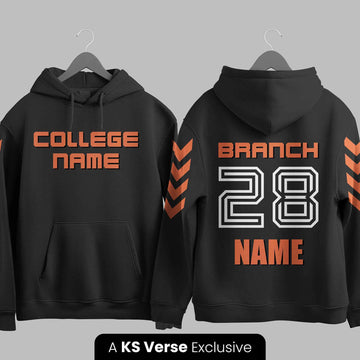
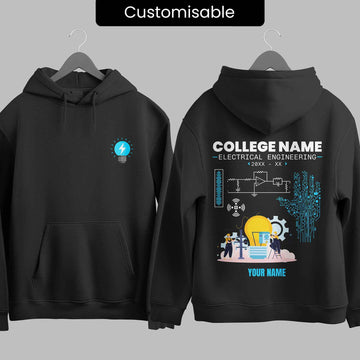
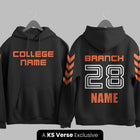
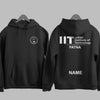
And honestly? If you're going to be up late building something real, you might as well be comfortable doing it. The 320GSM heavyweight hoodies from KS Verse have become basically standard issue in cold-campus hostels — not because they're merch, but because they're genuinely built for long sessions in under-heated library rooms.
The CGPA Question (Because You Were Going to Ask)
CGPA still matters. It's the ticket to the room, not the win. Most top companies have a 7.0–7.5 cutoff for shortlisting. Clear that floor, and then your skill stack is what separates you from 200 other students in the same room.
Don't sacrifice your core academics chasing breadth. That's not T-shaped thinking — that's just chaos. Protect your vertical by maintaining your academic baseline. Build horizontal skills during summers, electives, and weekends.
Placement Prep Timeline for T-Shaped Skill Stacking
If You're in 2nd Year Right Now
- Identify your vertical domain — don't switch more than once
- Start one horizontal skill (pick communication or data literacy first)
- Join one club or community that forces cross-functional exposure
If You're in 3rd Year (Pre-Placement Season)
- Your vertical should be interview-ready — projects, GitHub, results
- Add a second horizontal skill that pairs with the first
- Internship should stress-test your combination, not just your vertical
If You're in Final Year Right Now
- Stop adding new skills — sharpen and articulate what you already have
- Build one strong narrative that connects your vertical + horizontals into a story
- Practice explaining your T-shape in interviews: "My core is X. I also bring Y and Z, which helped me do [specific result]."
Students at VIT and other campuses with diverse batch profiles often have a natural edge here — exposure to peers from different domains already builds horizontal thinking if you're paying attention.
Final Take: The T-Shape Isn't a Hack — It's a Commitment
Skill stacking isn't a cheat code. It's a long game. The students winning 2026 placements started building their T-shape in their second year, quietly, without announcing it on Instagram.
They're the ones who can walk into an interview and say — "Yes, I built the backend. Yes, I also understand why the feature exists, who uses it, and what we'd measure to know it's working." That combination? That's not luck. That's a T-shape doing its job.
Build yours. Start now. Wear the process like it's yours — because it is.